There is a famous quote in the startup world: “Ideas are worthless; execution is everything.”
Many people enter the daycare industry believing that simply opening their doors is enough. They assume that if you rent a space, renovate it, and secure a license, success will naturally follow. They view “daycare” as a simple task.
They couldn’t be more wrong.
Daycare is a sophisticated service-based business. It requires branding, positioning, marketing, and the ability to build trust with families who are trusting you with their most precious little ones for eight hours a day. When an owner fails to execute on these fronts, the business suffers. But for the right buyer, that failure represents a massive opportunity.
Who Should Avoid a Failing Business?
If you are coming from an outside industry—for example, shifting from banking to childcare—buying a failing center is not the way to start. A failing business is like a broken machine; if you don’t have the technical expertise to diagnose why it’s broken, you will only end up pouring money into a bottomless pit.
The “Turnaround” Opportunity
Often, a business isn’t failing because of a bad location or poor market demand; it is failing because of poor execution. The owner likely struggled with niche positioning, lead generation, staffing culture, or operational efficiency.
Of course, there is one major exception. For example, if a center is paying $50,000 in monthly rent for a capacity of 50 children, the math will never work. That business is doomed to fail by its lease, not its operations. That is a failure of due diligence, not execution.
The Comparison: Scratch vs. Turnaround
Let’s look at the numbers. Building from scratch is a massive, capital-intensive marathon:
- The Wait: You are looking at 4 to 12 months for building permits, potentially even longer if you trigger a minor variance or site plan approval.
- The “Dead Rent” Trap: While you wait for licenses and renovations, you are paying rent. If you pay $15,000/month for a year, you’ve sunk $180,000+ into an empty building before you’ve enrolled a single child.
- The CapEx: A high-quality renovation can easily run $500,000 to $1 million depending on size.
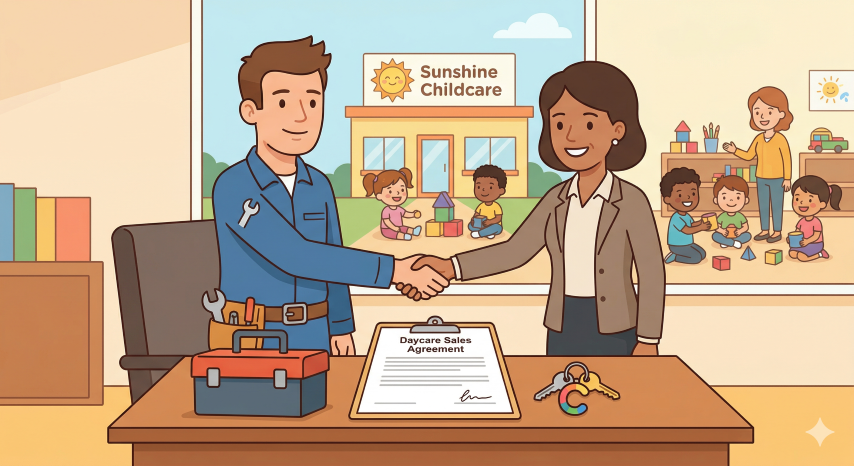
On the other hand, buying a failing center is a “pre-baked” asset. If someone spent $700,000 on a build-out and is now selling for $300,000, you are effectively buying their equity for pennies on the dollar. You skip the 12-month wait, you slash your renovation costs by 50% or more, and you inherit existing infrastructure and often, a small base of students and a pre-hired team.
The “Execution” Factor: A Real-World Example
A real world example, there was a non-CWELCC center that was about 20% full under the original owner for about a year. The original renovation cost was about $700K. It was sold for $300K to an experienced operator. Within days of the new management taking over, the centre increased 5% more students immediately. It shows that experience matters.
Are there any Failing CWELCC Businesses for Sale?
Typically, most CWELCC businesses do not fail. Therefore, that scenario is unlikely to happen.
Final Thoughts
Buying a failing business is an excellent way to expand your footprint or enter the market, but only if you have the playbook and the cash to stay afloat for a period of time. It is not for the faint of heart, and it is not a “magic button” for success. It requires a deep understanding of the Ontario childcare landscape, a firm grasp of your pro-forma, the ability to execute on the marketing and operations that the previous owner ignored, and operating cash for the time that you need to breakeven.
Are you ready to turn a failing center into a thriving one? If you have the industry experience but need the tools, assessments, or operational blueprints to execute a turnaround, check out our resources at Operator Journey.